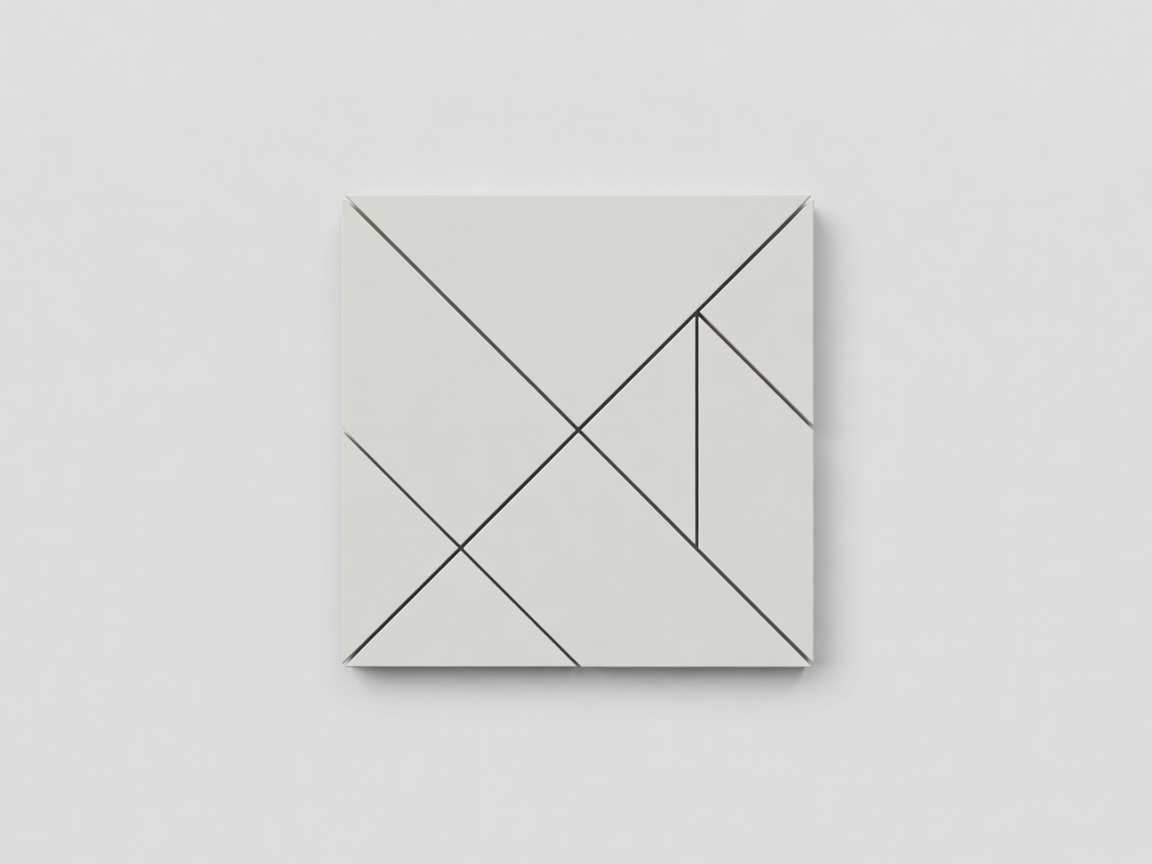
China: manuals, commentaries and a box of seven pieces
The Nine Chapters on the Mathematical Art (Jiuzhang Suanshu) is a collection of practical problems — land measurement, grain exchange, taxation, construction — compiled by around the first century CE. Its most famous reader, Liu Hui, wrote a commentary in 263 CE that added justifications, including an approach to estimating π with inscribed polygons. The lesson for puzzle-solvers is that Chinese mathematical writing often presents a problem, an answer and a method; the reasoning was frequently supplied by commentators.
Later manuals continued this pattern. The Sunzi Suanjing introduced the remainder problem we solve on the number patterns page, and Yang Hui's thirteenth-century works preserved both the arithmetic triangle and studies of magic squares.
The tangram (qiqiaoban, "seven boards of skill") is much more recent than often claimed. Published tangram books appear in China in the early nineteenth century, and the puzzle then spread quickly to Europe and the United States. Stories about an ancient inventor named "Tan" are a later invention.
The tangram is thousands of years old.
Its documented history begins around the early 1800s in China; claims of great age are not supported by sources.
Japan: temple geometry, challenge chains and modern logic puzzles
In 1627 Yoshida Mitsuyoshi published Jinkōki, a popular arithmetic book teaching soroban (abacus) methods and everyday calculation. Later editions included unsolved problems as challenges to readers. Other authors answered them in new books and posed fresh problems of their own — a chain of idai ("bequeathed problems") that pushed wasan, Japanese mathematics, forward. Seki Takakazu, active in the late seventeenth century, worked within this culture and developed determinants independently of European mathematicians.
Sangaku were wooden tablets hung in Shinto shrines and Buddhist temples during the Edo period, roughly 1603–1868. They displayed geometry problems — often circles packed inside triangles or fans — with an answer and sometimes no solution, inviting visitors to work it out. Many were offered by farmers, merchants and samurai rather than professional scholars. Several hundred survive.
A sangaku-style challenge with full reasoning
Problem
Two circles of radius 4 and 1 sit on a straight line and touch each other. How far apart are the points where they touch the line?
Step 1. Join the centres. Because the circles touch, the distance between centres is 4 + 1 = 5.
Step 2. The centres are at heights 4 and 1 above the line, a vertical difference of 3.
Step 3. The horizontal distance d forms a right triangle with sides 3 and d and hypotenuse 5, so d = √(25 − 9) = 4.
General rule: for radii R and r, the distance is 2√(Rr). Here 2√(4 × 1) = 4. Diagram in words: a large circle and a small circle resting side by side on a floor line, touching each other once.
Source context
Hidetoshi Fukagawa and Tony Rothman, Sacred Mathematics: Japanese Temple Geometry (Princeton University Press, 2008).
In the twentieth century, the Tokyo publisher Nikoli built a culture of hand-made logic puzzles. Founder Maki Kaji named the number-placement puzzle "Sudoku" in 1984. Credit for the format itself goes to Howard Garns, whose "Number Place" appeared in Dell magazines in the United States from 1979. KenKen, which adds arithmetic cages, was created by the Japanese teacher Tetsuya Miyamoto in 2004. Tracing these origins honestly shows exchange between places rather than one isolated invention.
India: verse problems, metres and a famous number
Bhaskara II's Lilavati, written in 1150, presents arithmetic and geometry largely in Sanskrit verse, with problems about bees, peacocks and pearls addressed to a listener. Earlier, Pingala's work on poetic metre (Chandaḥśāstra) prompted centuries of combinatorial commentary, including the counting sequences discussed on our patterns page. Board games such as moksha patam taught moral lessons through chance, and became snakes and ladders in Victorian Britain.
Modern Indian recreational mathematics includes D. R. Kaprekar's number routines and, at a far more advanced level, Srinivasa Ramanujan, whose partition formulas grew partly from a fascination with numerical patterns.
Korea and Southeast Asia
The Joseon-era scholar Choi Seok-jeong (1646–1715) described, in his treatise Gusuryak, a 9×9 arrangement now recognised as a pair of orthogonal Latin squares — a structure Leonhard Euler studied in the 1780s. Korea's baduk culture, meanwhile, produced some of the world's strongest Go players. In Malaysia, Indonesia and Brunei, the sowing game congkak remains a living counting game, discussed on our strategy page.
Ask of every puzzle: who made it, for whom, and what did they expect the solver to learn?